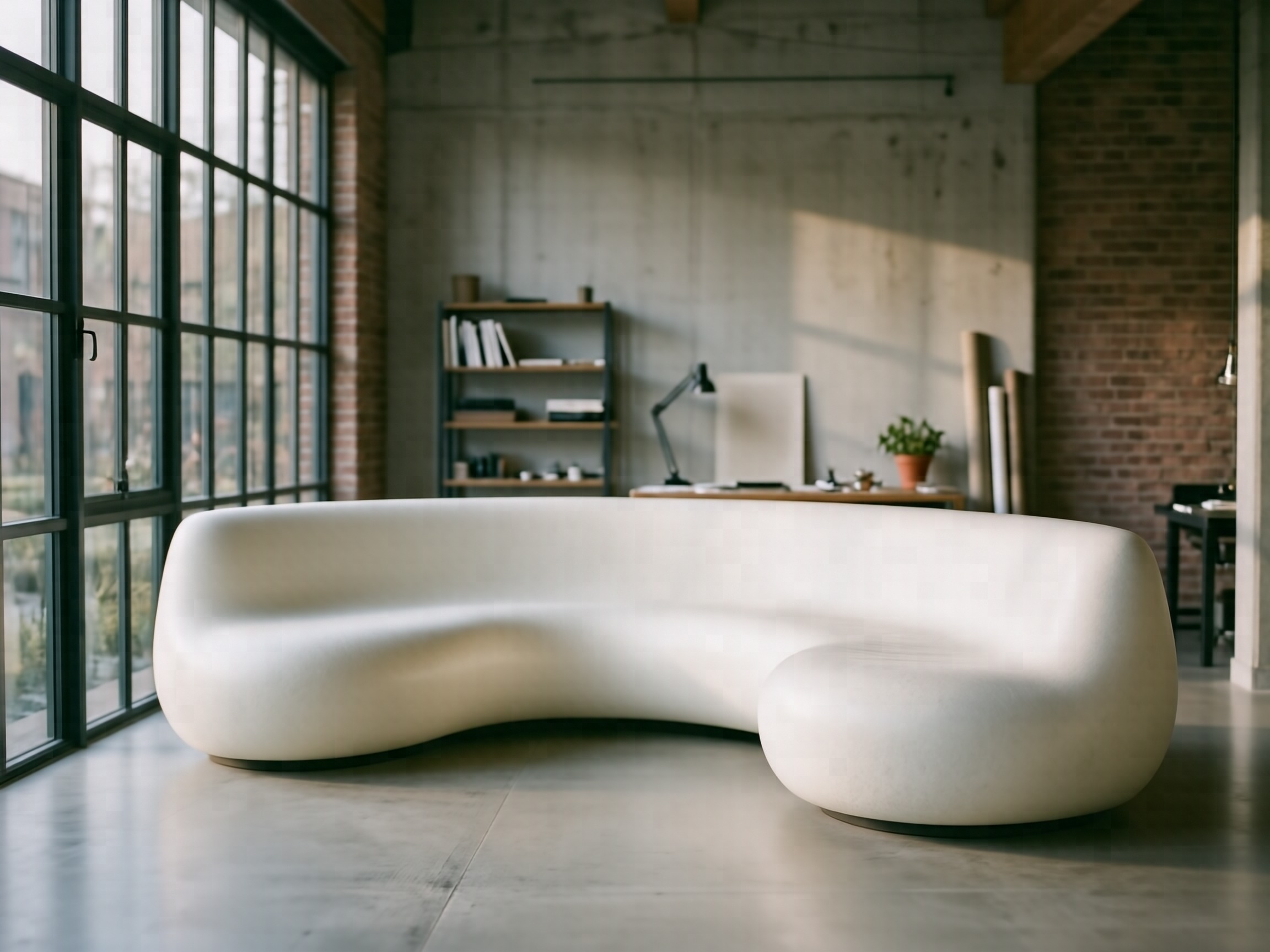
The grid was a manufacturing decision before it was a style
The twentieth century's love of the right angle had less to do with aesthetics than with logistics. Steel comes in straight sections. Plywood comes in flat sheets. Glass is floated flat. Concrete is poured into formwork, and flat formwork is cheap because it can be built from those same straight, flat products. Once a construction economy is organized around orthogonal parts, orthogonal buildings cost the least, and a philosophy tends to grow up around whatever is cheapest.
Curves never actually disappeared. Gaudí's Casa Batlló, Eero Saarinen's TWA Flight Center, Niemeyer's Brasília, Utzon's Sydney Opera House — all sit inside the modern era, and all required extraordinary effort. The Sydney Opera House shells famously had to be rationalized into segments of a single sphere before anyone could build them. That is the tell: for most of the century, a curve was a problem to be solved rather than a form to be specified.
So the recent return of contour is not a rebellion against modernism. It's what happens when the cost penalty on curvature falls far enough that designers stop self-censoring.
What changed first: the software, then the cutting tools
The hinge point is well documented. To build the Guggenheim Museum Bilbao, Frank Gehry's office adopted CATIA, software developed for aerospace, to describe and engineer surfaces that conventional architectural CAD could not handle. The museum was built between 1993 and 1997, and it did something more important than look striking: it proved that a complex curved envelope could be modeled, costed, fabricated and assembled within a real budget and schedule.
Everything since has been an extension of that logic. NURBS modeling made double curvature a normal thing to draw. Parametric tools made it a normal thing to adjust. CNC routers, five-axis mills, waterjets and robotic arms made it a normal thing to cut. Laser scanning closed the loop by letting fabricators verify that what came off the tool matched the model. The curve stopped being a drawing problem and became a data problem, and data problems get cheaper every year.
The consequence is subtle but real: curvature is no longer a signal of budget. A contoured bench or a molded reception counter is now a specification choice, not automatically a luxury statement.
What changed second: evidence that people respond to contour
Architects had long argued intuitively that soft geometry feels calmer. In 2013, a study in the Proceedings of the National Academy of Sciences by Oshin Vartanian and colleagues gave the argument an empirical anchor: participants viewing curvilinear interior spaces rated them as more beautiful than rectilinear ones, with corresponding activity in brain regions associated with aesthetic evaluation. Worth noting for honesty's sake, the same study found contour did not change approach–avoidance decisions — people did not necessarily want to *enter* curved rooms more. Curvature affected judgments of beauty, not behavior.
Running alongside this, biophilic design moved from niche theory to briefing language. Terrapin Bright Green's 2014 publication "14 Patterns of Biophilic Design" codified a set of spatial strategies for connecting buildings to nature, including biomorphic forms and patterns — contoured, non-rectilinear geometry that references natural shape without imitating it literally. Once a framework has named something, specifiers can ask for it.
I'd treat the research as supportive rather than conclusive. Preference studies measure preference; they do not prove that a curved lobby makes anyone healthier. But combined with the fabrication shift, they gave curvature professional legitimacy it hadn't had since art nouveau.
Four ways a curve actually gets built
And why they produce different results
Trend pieces tend to stop at the image. What separates a convincing curve from an awkward one is almost always the method, because each method has a natural radius and a natural finish.
- **Bent or faceted sheet** — metal, plywood, solid surface. Excellent for single curvature, i.e. surfaces you could unroll flat. Double curvature usually means faceting, and facets read as facets under raking light.
- **Formed concrete and GFRC** — heavy, permanent, superb for large architectural mass. Needs formwork or a mold anyway, and the joints and pour lines become part of the language.
- **Tension structures and fabric** — curvature comes from the physics of the membrane. Beautiful spans, but the shape is constrained by the forces, not chosen freely.
- **Molded composites (GRP/FRP)** — a hand-laid fiberglass skin taken from a tooled mold. Free double curvature, seamless surfaces, low weight relative to stiffness, and a gelcoat face that can be sanded and polished to a continuous finish.
Where molded fiberglass sits in the shift
Composites entered architecture through boats, pools and transport, and the reason is the same reason they suit contoured design now: the mold carries the geometry. Once the tooling exists, the hard part is done, and a complex compound surface costs little more to reproduce than a simple one. That inverts the old grid economics almost exactly.
Zaha Hadid Architects' Heydar Aliyev Center in Baku is the clearest large-scale demonstration — a continuous folded surface clad in glass-fiber reinforced panels precisely because no sheet material could follow that geometry without seams every meter. At furniture and landscape scale the same principle applies with far less complexity. A lounger, a planter, a pool-side form or a garden pod can be a single monocoque shell with no fasteners, no visible joints and no hardware to corrode.
This is where our own work sits. In the atelier in İzmir, the sequence is unglamorous and matters more than the render: build the mold, lay up the glass by hand, demold, fair the surface, sand through grits, polish. Hand lay-up is slower than pressing panels, but it gives control over laminate thickness where a piece needs stiffness, and it makes one-off or low-volume geometry viable — which is exactly what architectural projects tend to need. The projects we take on usually start as a curve someone could draw but couldn't source.
A practical note for specifiers: color and finish behave differently on a curved gelcoat surface than on a flat swatch. Gloss on a compound curve produces moving highlights; matte reads softer but shows fingerprints differently. This is the main reason we send physical samples rather than relying on screen color.
How to read a curve well
Designers develop an eye for this quickly, but it's rarely written down. A few things worth checking when you evaluate curved work, whether it's a building envelope or a bench:
**Continuity.** Where two surfaces meet, do the highlights flow through the junction or break at it? Tangent continuity looks acceptable; curvature continuity looks inevitable. Most of what reads as "cheap curve" is a continuity break.
**Highlight lines.** Stand so a window or strip light reflects along the surface and walk the length of it. Flat spots, ripples and sanding waves appear in the reflection long before they appear in a photograph.
**Radius discipline.** Curves drawn from a consistent family of radii feel resolved. Arbitrary radii look like a software accident.
**Edge and parting-line placement.** On a molded piece, the mold has to split somewhere. A well-planned parting line hides in a natural edge; a careless one runs across a visible face.
What the shift doesn't solve
Two honest caveats. First, curvature is not automatically better. A contoured form in a space with no room to move around it becomes an obstacle, and soft geometry applied to everything produces its own monotony. The most convincing contemporary interiors use curves selectively — one moment of contour against otherwise disciplined orthogonal planning.
Second, composites carry a real end-of-life question. Thermoset laminates are not straightforwardly recyclable the way aluminum or steel is, and anyone telling you otherwise is selling something. The credible counterargument is longevity: a GRP shell that survives outdoors for decades, can be repaired locally and can be re-gelcoated or refinished rather than replaced, amortizes its footprint across a long service life. That's a durability argument, not a recycling one, and it should be made as such.
My own read is that the grid isn't going anywhere — it remains the cheapest way to enclose space, and structure will keep wanting straight lines. What has genuinely changed is the default. Curvature is now available to projects that aren't landmark museums, which means the interesting question has moved from *can we* to *should we, and where*.
In short
The return of curved architecture isn't a style cycle swinging back. It's the result of three converging changes: software that can describe complex surfaces, machines that can cut them, and a research and design vocabulary that made specifying them defensible. Molded fiberglass sits comfortably inside that shift for an unromantic reason — the mold absorbs the geometric complexity once, so curvature stops being the expensive part. Read the curves around you by their method and their surface continuity, and the trend starts to look less like fashion and more like a change in what is buildable.
If you're working on a project where the geometry is drawn but the fabrication route isn't settled, our collections are a reasonable place to start, and we're always glad to talk through moldmaking and finish options with designers on trade terms.
Sources
- (PDF) Impact of contour on aesthetic judgments and approach-avoidance ... researchgate.net
- [PDF] Impact of contour on aesthetic judgments and approach-avoidance ... semanticscholar.org
- Impact of contour on aesthetic judgments and approach ... neuroaesthetics.med.upenn.edu
- Impact of contour on aesthetic judgments and approach-avoidance decisions in architecture (Vartanian et al., PNAS, 2013) pnas.org
- (PDF) Preference for Curvilinear Contour in Interior Architectural ... researchgate.net
- Impact of contour on aesthetic judgments and approach-avoidance ... ucrisportal.univie.ac.at
- Impact of contour on aesthetic judgments and approach-avoidance ... pmc.ncbi.nlm.nih.gov
- Impact of contour on aesthetic judgments and approach-avoidance ... ui.adsabs.harvard.edu
- Impact of contour on aesthetic judgments and approach-avoidance ... vbn.aau.dk
- Impact of contour on aesthetic judgments and approach-avoidance ... pnas.org
- 14 Patterns of Biophilic Design — Buckminster Fuller Institute bfi.org
- 14 Patterns of Biophilic Design — Terrapin Bright Green (PDF) globalwellnessinstitute.org