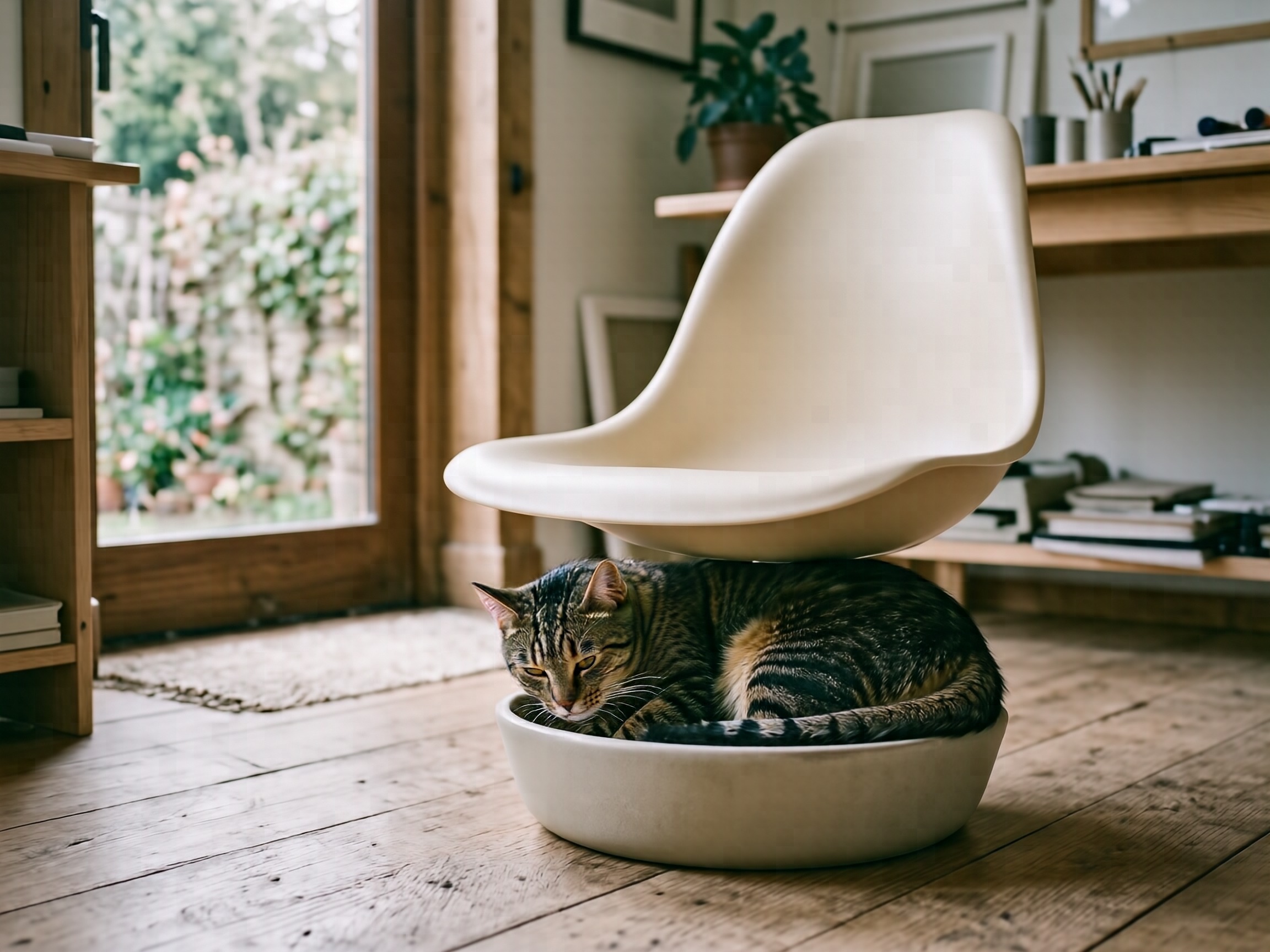
The brief your cat is already writing
Watch a cat circle a room before it settles and you're watching a short evaluation. Veterinary behavior guidance describes the same cluster of needs again and again: safe places to retreat, elevated vantage points, resources that can be reached and left without conflict, and control over who or what can approach. The AAFP and ISFM Feline Environmental Needs Guidelines organize this into five pillars, and two of them — a safe place, and multiple separated key resources including resting and elevated areas — are directly a furniture problem.
Translated into the language of a workshop, a cat's brief reads roughly like this: put me above the traffic, give me a back and at least one side I don't have to watch, keep the surface warmer than the room, let me see the door, and don't make me commit to a space with only one way out. Everything else — color, silhouette, whether it matches your sofa — is yours to decide.
The useful move is to turn each of those behavioral preferences into something you can measure with a tape and a thermometer. Below, each factor gets a criterion. Some are grounded in published veterinary guidance; some are conventions we and other makers use because they work. I'll flag which is which.
Height: the vantage point is the product
Criterion: a usable perch between roughly knee height and eye height
Elevation is the single strongest predictor of whether a cat adopts a piece. Height reduces the number of directions a threat can arrive from, puts the cat above dogs, toddlers, and vacuum cleaners, and improves the view. Feline environmental guidance explicitly lists elevated areas as a core resource, not a luxury.
In practice, there's a band that works for furniture rather than wall shelving. Below about 16 inches, a cat reads a surface as floor — fine for sprawling, useless for surveillance. Between roughly 20 and 40 inches you get the sweet spot for a bench, counter edge, or pod shoulder: high enough to feel like a perch, low enough that an older or arthritic cat can reach it in one hop or two steps. Anything above 50 inches wants a deliberate route — a lower step within about 12 to 16 inches of vertical rise.
That staging rule is a designer convention, not a published standard. But it's the difference between a tall piece a cat uses daily and a tall piece a young cat uses and an eleven-year-old cat abandons.
Enclosure: three sides beat four
Hiding is a primary coping behavior, not a sign of an unfriendly cat. A well-known Utrecht study of newly arrived shelter cats found that animals given a hiding box showed lower stress scores than those without one — the box did work that no amount of space alone could do.
But full enclosure and refuge aren't the same thing. Most cats in a secure home want partial cover: something solid at the back, a wall or raised lip on one or two sides, and an open front with a clear view. That's the geometry of a shelf under a chair, a wheel arch, a deep bowl seat, a pod with a generous mouth. A fully enclosed box with one small opening is a hiding place for a frightened cat; a three-quarter shell is a resting place for a relaxed one.
Measurable version: aim for a back and at least one side rising about 6 to 10 inches above the cushion plane, a roof or overhang if you can manage it, and an opening wide enough that the cat never has to squeeze — roughly 8 inches minimum, more for large breeds. Two exits, or one very open face, beats a single narrow mouth. Cats avoid spaces that can be blocked.
The curled sleeping footprint is smaller than people expect. A pad of about 16 by 16 inches holds most adult cats in a curl; a loaf or stretch wants closer to 20 by 14. Oversizing a nest doesn't help — contact with the sides is part of the appeal.
Warmth: cats are not thermally like us
This is the factor most furniture gets wrong. The thermoneutral zone for domestic cats is cited in ISFM/AAFP veterinary environment guidance as roughly 86–100°F (30–38°C) — far above the temperature most of us keep our homes. A cat in a 70°F living room is, thermally speaking, below its comfort band and is spending energy on it. That is why your cat tracks the sun across the floor, sits on the warm laptop, and ignores the bed in the drafty hallway.
So warmth isn't a nicety; it's a selection criterion. You can engineer it without electronics:
Note the difference between a surface that *is* warm and a surface that *feels* warm. Stone and steel sit at room temperature but pull heat out of a body fast. A composite shell at the same temperature feels markedly warmer because it conducts poorly. Fiberglass laminate is a weak conductor, which is why a gelcoat seat with a pad in it reads as comfortable while a marble ledge reads as cold — same thermometer reading, different experience.
- Place the piece where sun lands for part of the day, or near — not directly against — a radiator or vent.
- Choose shell materials that conduct heat poorly, so the cat's own body heat stays with the cat.
- Keep the resting surface off cold floors; even a few inches of air beneath reduces heat loss.
- Add a soft insert. A hard shell is the structure; a wool or fleece pad is the thermal layer.
Sightlines: let them watch the door
Cats resting in a home still monitor it. A perch facing a blank wall gets less use than an identical perch facing the room's main entrance. The guidelines' emphasis on separated resources and a sense of control is, spatially, about being able to see what's coming and choose whether to deal with it.
Two practical tests before you fix a piece in place. First, crouch to the height of the resting surface and look: can you see the doorway, and is your back covered? Second, trace two exit paths from the spot that don't cross each other. If the only way out passes the dog bed or the hallway everyone uses, expect the cat to use the piece at night and avoid it by day.
In multi-cat homes this matters more than any feature of the furniture itself. Several modest perches in different rooms, out of sight of one another, will be used far more than one spectacular tower in the living room.
Surface, claw, and the honest limits of a hard shell
Cats need grip to land and launch. A glossy, perfectly flat seat at height is a slide; cats learn this in one attempt and never return. The fix is friction rather than texture everywhere: a matte or satin area where they land, a raised lip, or a non-slip insert that the shell is shaped to hold.
Scratching is maintenance behavior and territorial marking — it won't be designed away, only redirected. Pair any sculptural piece with a sisal or cardboard post within a few feet of it, ideally on the route the cat takes to get there. A post placed where the cat already stretches after waking will be used; one placed where it looks tidy usually won't.
Hard shells are good at hygiene and bad at softness, and it's worth saying that plainly. A molded homeware or pet piece in GRP wipes clean of hair, litter dust, and the occasional accident, holds a complex curve that upholstery can't, and survives outdoors. It is not, by itself, a comfortable sleeping surface. The design logic is shell plus insert: the laminate provides the geometry, elevation, enclosure, and low thermal conductivity; a washable pad provides the softness. Anyone who tells you a bare hard shell is where a cat wants to sleep hasn't watched many cats.
Curved forms happen to suit this work, which is part of why we keep returning to them — a continuous shell gives you back, side, lip, and base in one piece, with no corners for hair to collect in. We wrote about that broader shift in why curved architecture returned.
A short spec you can check with a tape
If you're briefing a maker, specifying a piece for a client, or just deciding where to put what you already own, these are the criteria worth writing down. The behavioral basis is veterinary; the specific numbers are our working conventions, offered as starting points rather than rules.
In short
Cats aren't choosing between your furniture and the cardboard box on aesthetic grounds. They're checking height, cover, warmth, sightlines, and exits — and the box often scores better. The encouraging part is that every one of those factors converts into something a designer can specify: a perch height, a lip depth, a material that doesn't steal body heat, an orientation toward the door, a second way out. Get those right and the styling is free to be whatever you want it to be, because the cat has already agreed to use it.
If you're working on a pet piece and want to see how a gelcoat surface actually feels in the hand before you commit, our samples box covers the finishes and colors we work in. We're happy to talk through a brief at the atelier stage, when geometry is still cheap to change.
Sources
- (PDF) AAFP and ISFM Feline Environmental Needs Guidelines researchgate.net
- AAFP and ISFM Feline Environmental Needs Guidelines (Journal of Feline Medicine and Surgery, 2013) journals.sagepub.com
- 2022 ISFM/AAFP Cat Friendly Veterinary Environment Guidelines pmc.ncbi.nlm.nih.gov
- Indoor and outdoor management for cats: inferences about the welfare and cat-caretaker relationship - ScienceDirect sciencedirect.com
- AAFP and ISFM Feline Environmental Needs Guidelines journals.sagepub.com
- AAFP and ISFM Feline Environmental Needs Guidelines canadianveterinarians.net
- 2022 ISFM/AAFP Cat Friendly Veterinary Environment Guidelines - Samantha Taylor, Kelly St Denis, Sarah Collins, Nathalie Dowgray, Sarah LH Ellis, Sarah Heath, Ilona Rodan, Linda Ryan, 2022 journals.sagepub.com
- (PDF) AAFP and ISFM Feline Environmental Needs Guidelines academia.edu
- Pillar #1 Provide a Safe Space - Aristokatz aristokatzvet.com
- The heat is on: the feline TNZ veterinaryirelandjournal.com
- (PDF) Beyond the classic thermoneutral zone: Including thermal comfort researchgate.net
- What room temperature do cats prefer? pictures-of-cats.org